
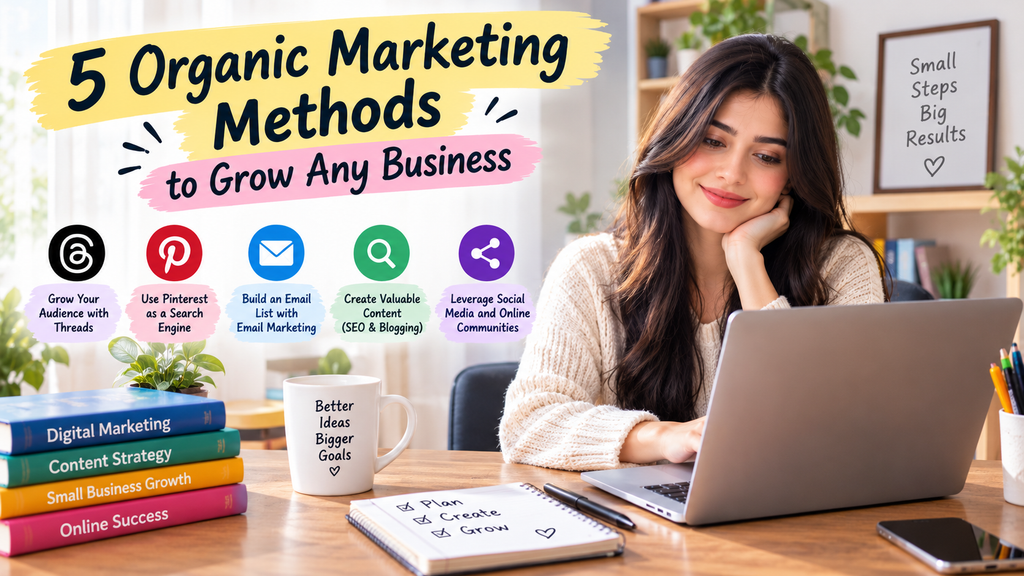
Marketing Methods to Grow Any Business
You don’t need an ad budget to grow a business. It’s what organic marketing is all about. You get free attention, free traffic, and even free sales. In other words, you never pay for advertisements. This approach works for online stores, physical businesses, and service-based businesses alike.
These organic marketing methods also suit complete beginners. You can even start without showing your face. Better still, you only need to master one or two of them. Nevertheless, it would be prudent to try all five approaches before settling on any one. Below is the process for each approach.
Method 1: Grow Your Audience with Threads
Why Threads Is Worth Your Time
Threads is the newest platform in this list. Think of it as the Twitter or X of Instagram. Many people expect little from it at first. However, it can connect you with a lot of new people and a fresh audience.
It’s also one of the easiest platforms to grow on right now. Competition is still low. At the same time, plenty of people already use it. In fact, far more people use it than most business owners think.
The algorithm helps too. It’s smart. It shows your posts to people who are interested in your content. As a result, you don’t have to fight for attention the way you do elsewhere.
Threads can even support passive income. An expanding audience helps you get more people within your reach. After that, you can divert them towards your products or services. So the platform helps your online business and builds income on the side.
Use AI to Come Up with Post Ideas
Coming up with ideas for Threads can be tough. Luckily, there’s an easy fix. An AI tool can do brainstorming for you. It can also help with digital product ideas, hook ideas for TikTok and Instagram, and general marketing ideas.
Using it is simple. First, open the tool. Then ask for ten trending Threads for today in your niche. It is important to know your niche like business, social media, etc. Once you have done that, the software will give you a list of threads related to your topic.
Within seconds, you have ideas you can post. Since these concepts are popular, they will enable you to gain more followers. This will save you a lot of time. You will never struggle with an empty page.
How Service-Based Businesses Can Use Threads
Threads is great for service-based businesses. The reason is location. If you mention your city in your Threads, the platform may show your posts to people in that city. It may even do this on its own.
It is very important for the local services. For instance, discuss issues that concern your work and mention the name of your town. Then local people see your content. In essence, the algorithm knows where people are, and you can make use of this information.
Method 2: Use Pinterest as a Search Engine
Pinterest Is More Than Social Media
https://business.pinterest.com/en-gb
Many people sleep on Pinterest. They treat it like another social platform. In reality, it’s a search engine. They make use of it more than one would think possible. This implies that they actively seek out information there.
Any type of business can use Pinterest. It doesn’t matter if you sell products or offer a service. If they may be looking for it, then you can make yourself known.
Getting Started
Pinterest is easy to start. You just have to post. There’s no complicated setup. You can post once a day. Or you can post a whole batch in one day and recycle content later.
Choose whatever fits your schedule. Also, few businesses use Pinterest well. Therefore, you face much less competition than on other platforms.
Repurpose Content You Already Made
It’s not necessary for you to develop new content for Pinterest because all you have to do is recycle your existing content. This means taking videos that you created for TikTok and Instagram and saving them without any watermarks before uploading them to Pinterest.
Several recycling sites can save videos without watermarks. You can also search for an Instagram saver tool. After that, post the video as a new pin. This way, one piece of content works on several platforms.
Add Keywords to Every Post
Next, add keywords to each post. Put them in the post itself. This helps Pinterest show your pin to the right people. In turn, you reach your target audience.
There’s no perfect formula here. Just think about what your audience would type into a search bar. An AI tool can also generate keywords for you. Then click post and let it work. Because competition is so low, the upside potential is high.
Method 3: Build an Email List with Email Marketing
Why You Need an Email List
Email marketing lets you own your audience. That matters because social media accounts can change overnight. Something might happen to your account. If it does, you still have a working email list. You can reach your people anyway.
Email also helps you earn more from sales you already get. It’s one simple strategy with a big payoff. Every responsible business owner should have it.
Many owners put it off. They assume it’s complicated. In fact, it’s not. Starting earlier would save you a lot of time. So don’t wait. Set it up now.
Ways to Collect Emails
There are many ways to get a customer’s email. First, think about what you sell. Then choose an offer that fits.
- Digital products: Give away a small digital product. In exchange, ask for an email or phone number.
- Physical products or services: Offer a discount. In return, ask for an email address.
- Physical businesses: Collect emails through reviews.
In fact, any time someone interacts with your website or online store, you can ask for their email. This helps you in two ways. You convert brand new customers. You also bring back customers who have shopped with you before.
How to Choose an Email Platform
Many email marketing platforms exist. This is definitely intimidating. However, you can simplify matters using just three questions. First, how affordable is it? Second, how user-friendly is it? Finally, how good is the quality of work it produces?
Try out some alternatives if you possibly can. Then choose the one that is right for your company.
Why Omnisend Works Well
Omnisend is a strong option. It covers email marketing and SMS marketing. It also offers pop-up forms, web notifications, and more. Its pricing is competitive for online businesses. There’s even a free plan at $0 per month.
As your business grows, pricing stays flexible. You can adjust it to what you need. Support is available 24/7 as well. For instance, a quick question can get an answer within minutes. That kind of help is valuable when you’re stuck.
How to Set Up Email Marketing with Omnisend
Step 1: Sign Up
First, open Omnisend and click Start free. The sign-up process takes only a couple of minutes. You can sign up with Shopify, with Google, or with an email address.
If you have a Shopify store, simply use that. Otherwise, use your email address. Next, select Ecommerce. Then verify your email and finish the sign-up process.
Step 2: Connect Your Store
Once you’re in, Omnisend asks you to connect your store. Select the online store host you use. Don’t have one yet? Then set up an online store first. You can also access the Omnisend app through your website host if needed.
After that, pick a plan. You can start at $0 per month. So there’s no pressure to pay upfront.
Step 3: Create a Sign-Up Form
Now it’s time to capture emails. Click Forms in your account. This is the most popular way to collect emails on your website. You will get a preview of your pop-up.
You can customize your pop-up in the way that suits you. All you can add is mentioned on the left-hand side. You can for instance add a field for phone numbers. Just click it and drag it over. To edit any text, click the text and change it.
However, don’t ask for too much information. Long forms can push people away. They may stop before they give you anything. So keep it short.
Step 4: Create an Email Campaign
Next, create your first campaign. Click Campaigns, then click Create email campaign. Need help with the subject line? Click Generate subject line. You’ll get a bunch of ideas.
Under the sender’s name, enter your business name. Then fill out the remaining fields. After that, move on to the templates.
Step 5: Choose and Edit a Template
This is the fun part. Omnisend has many templates for your campaigns. Scroll to one you like. Then click Use template.
Now edit it just like the form. You can add your logo and change the image. Everything is customizable. When you want to change something, click it. Options then appear on the right-hand side.
You can also add products straight to your email. Simply go to Quick add. There, you’ll find more items you can add to the campaign.
Step 6: Test and Send
Always test your emails first. Do this before you send it to everyone. Go to the Test button at the top right of your page. This will ensure that everything is functioning.
Once you’re done, click on the green Save & Choose Recipients button.
Then click the Preview campaign. After that, send it now or schedule it for later. To send right away, click Send now.
Each campaign appears in your list. Click the three dots to copy one. That’s useful if you want to resend the same campaign. The whole process takes less than 10 minutes. It’s easier than most people expect.
Abandoned Checkout Emails
Omnisend also offers an abandoned checkout feature. Here’s how it works. A customer visits your site and adds items to their cart. Then they leave without buying.
With this feature, you can target those customers. You pull them back in and encourage them to buy. As a result, it can improve conversions in your online store.
Start Now
Don’t wait to start email marketing. Many owners delay it for far too long. The setup is simple. With a platform like this, you can even start at $0. So start now and build your list from day one.
Method 4: Create Short-Form Content
One Piece of Content, Many Platforms
Short-form content is the organic marketing method that works best as a funnel. It mostly means Instagram and TikTok. Here’s the basic idea. Make one piece of content. Then distribute it to several platforms.
For example, create a video for TikTok or Instagram. Then repurpose it everywhere. Share it on Pinterest. Post it on Facebook too. Facebook alone can bring in strong results. Use as many platforms as you can.
Why Short-Form Content Works
This method grows your brand. It also makes you look more legitimate when people search for you. In addition, it gets a lot of eyeballs on your content.
Best of all, you don’t need money for ads. That makes it ideal for beginners. Many people who started with nothing have used this exact strategy. It has taken them from zero to a strong online presence in just a few years.
Treat It as a Funnel
View short-form platforms as a funnel. They send viewers to your online store. They also send viewers to your long-form content, which comes next. Beyond that, they lead people to anything else you sell.
So many opportunities come from mastering this one skill. It’s worth the time. Start with one platform. Then expand once you have a rhythm.
Method 5: Share Long-Form Content on YouTube
Your Description Is Real Estate
YouTube is the most powerful platform for long-form content. Your video description is like real estate. You can use it to give people value. You can also use it to promote your services.
Add links to products you sell too. In short, the description box can do a lot of work for you. Many creators overlook it.
Passive Income from Content
Most content-based platforms can also create passive income. YouTube is no exception. That’s a whole new layer of your business. Many owners don’t even know it exists.
Social media offers many ways to make money. All you have to do is post about your business. So you may as well do it.
Build a Personal Brand and Attract Clients
YouTube works especially well for growing a personal brand. It also suits service-based businesses. If you want to teach a little of what you do, this is the place.
For example, imagine you do lashes. You can share your lash techniques with others. That’s how you already share content on other platforms. On YouTube, you simply go deeper.
As a result, your channel grows. It can create passive income. It can also bring in more sales and clients. On top of that, your name becomes known more widely.
Bonus Method: Grow with LinkedIn
Why LinkedIn Matters
LinkedIn is another smart option. If you’re not on it yet, you should be. Some creators use only LinkedIn. They don’t have any of the other platforms in this list.
Even so, a LinkedIn page can bring in many good-quality people. These people may be interested in your offer or what you sell. For certain business owners, that’s enough.
What to Post on LinkedIn
LinkedIn is mostly written content. Thus, you can create posts through AI technology. Moreover, you can also design graphs in Canva. This is an excellent choice if you would like to provide visuals or data.
Whatever you post should depend on your business. Be relevant. Be clear.
Who Should Use LinkedIn
LinkedIn suits service-based businesses best. It also suits professionals. For example, it’s a good fit if you sell a course. It is yet another good way to build your business organically.
Organic Marketing – Which Strategy to Choose?
What strategy should be chosen? That will depend on your business. What does your business involve? Select the most appropriate option for you.
A small business or an online store: Opt for short-form marketing.
A service-based business: Opt for LinkedIn and YouTube.
Professional selling a course: Consider LinkedIn and YouTube.
You’ll probably master two of these methods. That’s all you need. Once they work, organic traffic comes to your offer or your online store. That’s the most important part.
Use each method as a funnel. Also, make the most of the audience you build. Leverage it for what you’re creating next.
Conclusion
Organic marketing helps you grow without ads. It also builds more than a business. You’re building digital assets too. Choose one or two strategies and implement them straight away. Stay committed to their use. Over time, your coverage and sales will grow steadily.

2 Comments on “5 Organic Marketing Methods to Grow Any Business Without Ads”