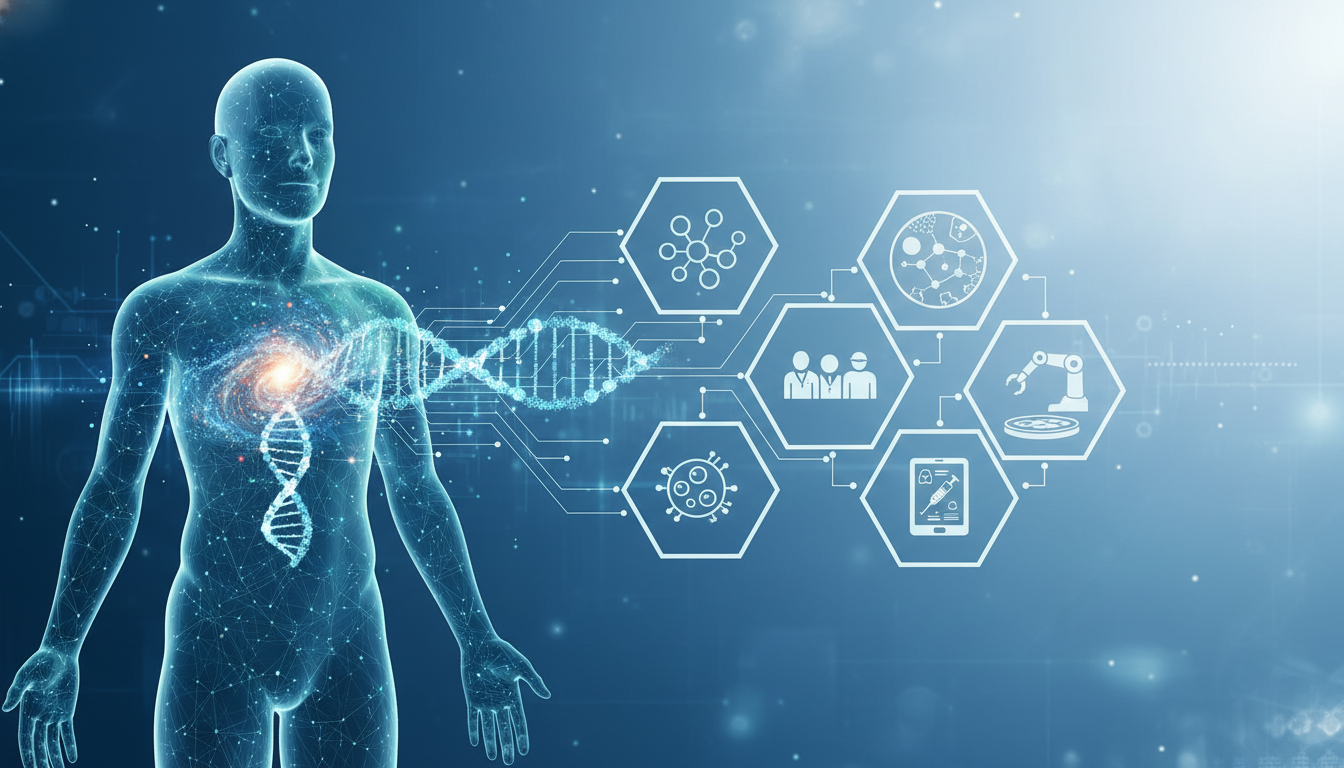
The Future of Artificial Intelligence in Healthcare and Personalized Medicine: How Your Health is Getting Smarter
Imagine walking into a doctor’s office, and instead of a generic check-up, you get a treatment plan built specifically for your DNA. No more “trial and error” with prescriptions. No more waiting weeks for a specialist to spot a tiny shadow on an X-ray. This isn’t science fiction; it is the reality we are stepping into right now.
I’ve been watching the tech space for over a decade, and nothing feels as personal as this. The Future of Artificial Intelligence in Healthcare and Personalized Medicine is about saving lives by making medicine proactive rather than reactive. It’s about moving away from the “one-size-fits-all” approach that has defined hospitals for a century.
We are seeing a massive shift. In this article, I’ll show you how AI is becoming the ultimate assistant for doctors and a guardian for patients. From predicting heart attacks before they happen to finding cures for rare diseases, the landscape is changing fast. Let’s look at what this means for you and your family.
What’s Inside This Guide
The Shift to Personalized Medicine
For a long time, medicine was a game of averages. If a drug worked for 70% of people, it was considered a success. But what about the other 30%? That’s where things got messy.
Personalized medicine changes that. It looks at your genetic makeup, your lifestyle, and even the environment you live in. AI is the engine that makes this possible. It can process billions of data points in seconds—something a human brain just can’t do.
Think of AI as a master librarian. It sifts through your medical history and compares it to millions of others. It finds patterns that tell your doctor exactly which treatment will work best for you. This is the core of The Future of Artificial Intelligence in Healthcare and Personalized Medicine.
AI as the Ultimate Diagnostic Tool
Early detection is the “holy grail” of medicine. If you catch a disease early, your chances of beating it skyrocket. This is where AI is truly shining right now.
Radiologists are already using AI to scan MRIs and CT scans. These algorithms are trained on millions of images. They can spot a tumor the size of a grain of sand that a tired human eye might miss after a long shift.
- Faster Results: AI can analyze an image in seconds, reducing wait times for anxious patients.
- Higher Accuracy: Studies show that AI-assisted screenings often have fewer “false positives” than traditional methods.
- Pathology: AI is now looking at tissue samples to identify cancer cells with incredible precision.
I find it fascinating that we aren’t replacing doctors. Instead, we are giving them “superpowers.” A doctor with an AI tool is like a pilot with a high-tech radar system. They still fly the plane, but they have much better data to stay on course.
Image Suggestion 1: A high-tech digital scan of a human heart with glowing data points. Alt-Text: AI technology analyzing human heart health for personalized medicine.
Speeding Up Drug Discovery and Clinical Trials
Did you know it usually takes about 10 to 15 years to bring a new drug to market? It also costs billions of dollars. Most of that time is spent on “guessing” which chemical compounds will work.
AI is flipping the script. It can simulate how a drug will interact with human cells on a computer before it ever touches a person. This is a game-changer for The Future of Artificial Intelligence in Healthcare and Personalized Medicine.
During the recent pandemic, we saw how fast science can move when tech is involved. AI helped researchers understand the virus structure in record time. In the future, we might see “digital twins”—virtual versions of patients—used to test drugs safely without any risk to real people.
Winning the Fight Against Rare Diseases
Rare diseases often get ignored because the “market” is too small for big pharma. AI makes it cheaper to research these conditions. It can find existing drugs that might work for a different disease, giving hope to millions who felt forgotten.
Wearables and Constant Health Monitoring
You probably have an Apple Watch or a Fitbit on your wrist right now. A few years ago, these were just fancy pedometers. Today, they are medical-grade monitors. They track your heart rate, oxygen levels, and even your sleep quality.
But the real magic isn’t the device; it’s the AI backend. Your watch can notice a tiny change in your heart rhythm (like Atrial Fibrillation) days before you feel a symptom. It can then send that data directly to your doctor.
This is proactive healthcare. We are moving away from “I feel sick, I’ll go to the doctor” to “My watch says I might get sick, I should check in.” This shift will save thousands of lives every year by preventing strokes and heart attacks.
The Rise of AI-Assisted Surgery
The idea of a “robot surgeon” sounds scary to some, but it’s actually making surgery much safer. These robots don’t think for themselves—they are controlled by highly skilled surgeons.
The AI helps by steadying the surgeon’s hand. It allows for “microsurgery” that is far more precise than a human could achieve alone. This means smaller incisions, less blood loss, and much faster recovery times for you.
I’ve talked to surgeons who say that using these tools is like having a GPS for the human body. It shows them exactly where the nerves and blood vessels are, reducing the risk of accidental damage. It’s a win-win for everyone involved.
Image Suggestion 2: A robotic arm performing a precise medical procedure in a modern operating room. Alt-Text: AI-assisted robotic surgery improving patient outcomes and recovery times.
Addressing Privacy and Ethical Concerns
We have to talk about the elephant in the room: Privacy. If an AI knows everything about your DNA and your health habits, who else has that data? This is a valid concern that we need to solve.
For The Future of Artificial Intelligence in Healthcare and Personalized Medicine to succeed, we need rock-solid trust. We need laws that prevent insurance companies from hiking prices based on your genetic risks. We also need to ensure that AI is “unbiased.”
If an AI is only trained on data from one group of people, it might not work well for others. We need diverse data sets to make sure everyone benefits from these breakthroughs, regardless of their background or where they live.
The Importance of the Human Touch
One thing I always tell people: AI will never replace the empathy of a nurse or the intuition of a doctor. It can’t hold a patient’s hand or explain a diagnosis with compassion. The goal is to automate the “boring” stuff—like paperwork and data entry—so doctors can spend more time actually talking to their patients.
Imagine a world where your doctor isn’t staring at a computer screen during your 15-minute appointment. Instead, an AI is taking the notes, and the doctor is looking you in the eye. That is the future I’m excited about.
Conclusion: The Road Ahead
The Future of Artificial Intelligence in Healthcare and Personalized Medicine is bright, but we are just at the beginning. We are moving toward a world where your treatment is as unique as your fingerprint. This isn’t just about cool gadgets; it’s about better outcomes, longer lives, and a more human approach to healing.
As we continue to integrate these tools, we must stay focused on the patient. Tech should serve us, not the other way around. If we get this right, the next generation will look back at today’s medicine and wonder how we ever survived without the help of AI.
The journey is just starting, and I, for one, am ready to see where it takes us. What part of this technology are you most excited about? Is it the better diagnostics or the personalized drugs? Whatever it is, the impact will be huge.
Frequently Asked Questions
Is AI going to replace my doctor?
No. AI is a tool, like a stethoscope or an X-ray machine. It helps doctors make better decisions, but the final call and the emotional support will always come from a human professional.
Is my health data safe with AI?
Privacy is a top priority. Medical AI systems must follow strict laws like HIPAA. Companies are working on “encrypted learning” where the AI learns from data without ever seeing your personal identity.
Will AI make healthcare more expensive?
In the short term, the tech is expensive. However, in the long run, it should save money by preventing hospital stays, reducing trial-and-error treatments, and making drug discovery much faster.
How soon will I see AI in my local clinic?
It’s already there! Many clinics use AI for scheduling, billing, and basic diagnostic support. You’ll see more advanced tools, like personalized cancer treatments, becoming common over the next 5 to 10 years.
whhjrrqzsfvnjgromttysiqeneqqgl