
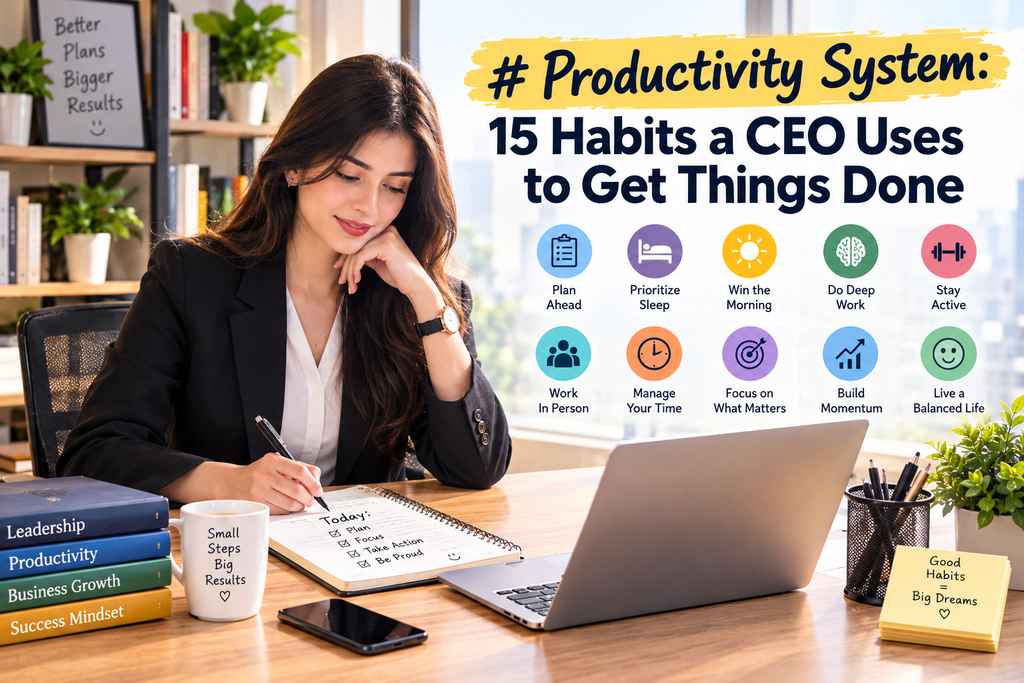
Same Hours, Wildly Different Results
You get 86,400 seconds every day. So does a billionaire. Nobody gets extra, and nobody gets less. But somehow, people end up in very different places. A simple productivity system can help you use those seconds more wisely.
Maybe you’ve heard the usual tips. Get up at 5:00 a.m., sit in a cold plunge, and eat the frog first. Most of that is just discipline for show, and it doesn’t really help.
But how do others manage to conduct their business, write, travel, and lead a balanced life? They follow a simple habits. A lot of it comes from smart business leaders who figured out what works. You don’t need all of it. Even one idea might change how your days go.
Start Your Productivity System the Night Before
Your Day Starts Before You Wake Up
Your day really starts the night before. If you plan it after you wake up, you’re already behind. Something urgent lands in your inbox, someone needs a reply, and suddenly you’re working on their list instead of yours. The whole day ends up reacting to things when it should be going where you chose.
Plan Tomorrow Tonight
Plan each day the night before. And Plan further ahead too, even months if you can. Give it 15 minutes and don’t skip it. Sit down and ask, “What’s the one thing I can do tomorrow that really moves the needle?” Big goals feel much easier to follow once you’ve asked that.
Make a Priority List, Not a To-Do List
Write a priority list, not a to-do list. A to-do list is only a wish. A priority list is a plan, because it forces you to pick what matters most. You can’t do everything. Nobody can.
Why Sleep Matters in Any Productivity System
https://www.apa.org/topics/sleep/why.html?utm_source=chatgpt.com
Stop Treating Sleep Like a Waste
Many people see sleep as lost time. It’s the opposite. Sleep affects decision making, not the clock. The prefrontal cortex of the brain is responsible for judgment and decision making, and when there is less sleep, it is badly affected. You feel sharp, but your brain is closer to driving drunk. After four hours of sleep, you can’t even tell how poor your choices are.
Build an Evening Wind-Down
Give yourself an evening routine. A little under-eye patch, some skin care, whatever tells your body the day is done. The switch matters. Going from 90 mph straight to deep sleep doesn’t work without a runway. If you want tomorrow to go well, the best thing you can do right now is go to sleep.
Win the Morning With a Productivity System
Get Light on Your Face
Rise early, about 5:30 or 6. If it is a sunny day, get sunlight on your skin. It resets your body clock for free and wakes your brain up. When there’s no sun, a sauna or a quick walk does the job.
Make Your Bed for an Easy Win
Making the bed isn’t about looking tidy. It’s a small win, and small wins pile up. Each one pushes you a little further through the day.
Journal and Skip Email
Try journaling next. Don’t write about feelings, write about what you want from the day. And stay off email and Slack for a while. The moment you open your inbox, you start working for other people. You’ve basically given away your best hours. Get clear on your own day first.
Protect the Most Expensive Real Estate
Your brain works best in the first few hours. Decisions come easier and ideas flow better. So that early window isn’t free time. It’s the most expensive real estate in your schedule, and you should guard it like money, because it really is.
Deep Work: The Heart of a Productive System
Do the Important Work First
Deep work should be done early in the day when it really counts. Decision fatigue is a fact. By 3 o’clock in the afternoon, your mind would have made thousands of decisions, and making the right ones becomes increasingly difficult.
Use One Simple Filter
Before undertaking an activity, ask yourself one question: is it leveraging work, supportive work, or noise?
Spend Your Best Hours on Leverage Work
Leverage work covers strategy, content, sales, writing, and big-picture thinking. Your best hours belong here.
Limit Support Work
Support work makes you feel busy. You tick boxes and answer messages, yet nothing new gets built. You’re just keeping things running. Give your most valuable time to work that grows over time.
Lift Something Heavy Every Day
Build Exercise Into Your Productivity System
Move your body every day, with no exceptions. Skip the nootropics and the pile of supplements. The best performance boost is lifting something heavy early. Most office work is typing and staring, all head and nobody. Very little of it makes you feel your own strength.
Why Heavy Weights Help
Lift something heavy and your problems shrink a bit. You tell your nervous system, “I’m capable, I can carry this.” That feeling follows you into the rest of the day.
Show Up Even When You Don’t Feel Like It
Show up on the days you don’t feel like it, even while traveling. That builds real discipline. Slowly, you prove to yourself that you do what you say you will. Put the gym in your calendar. It’s not there because you have spare time. It’s there because you can’t afford to skip it.
Work in Person When You Can
Research says face-to-face requests are 34 times more likely to get a yes than email. Another study found that people who share a space reference each other’s work three to four times more often. Remote work rarely matches that kind of momentum. If you can, work in the same room and build things together.
Save Time and Show Up Well
Combine Tasks
Efficiency isn’t only about what you do. How you do it counts too. Ask where you can do things in tandem. Ask where you might be able to look at the problem from an entirely new angle. A strange thought could end up saving you hours.
Comfortable Clothing
How you appear sends out a message, and your employees will get that message. Your choice of footwear is very significant. When your feet hurt, your brain spends the whole day on the wrong problem.
Nourish Your Mind Before
Consume brain food such as chia pudding with added fruits. The chia seeds are some of the highest sources of omega-3 fats. Feed your brain before you ask it to perform. You wouldn’t fuel a Ferrari with gas station coffee. Also, give every meeting a clear goal and a clear end time.
Make Work Come to You
Look for the hidden commutes in your workflow. A drive to a studio, a coffee shop, a shoot across town. Each trip is a leak. If you do something over and over, set it up in one place and let it come to you. That plugs the leak.
Schedule Your Days at the Office
Block One Midday Hour
Block at least one hour in the middle of the day at your desk. Use it to check in on the whole company. Approve what needs approval and clear the quick tasks.
Avoid “Got a Minute?”
Try to stop people from drifting in and out of your office all day. “Got a minute?” is the most expensive question in any office. It never takes one minute. It takes twenty. Train your team that you aren’t always free. That’s not rude. It’s how you stay focused.
Offer a Better Option
It won’t always work, but a simple reply helps. Try requesting a fast Loom video or Slack message first. Should you still feel that you need to hold a discussion, then we may arrange a 15-minute window on your schedule. Most of the time, however, the discussion will be unnecessary. That isn’t avoiding people. It respects everyone’s time, yours too.
Try Walking Meetings
When a meeting is a must, try walking. Go outside. The talk feels looser and people are more honest. Steve Jobs held almost all of his meetings on foot, and there’s a reason for it. Stanford found that walking boosts creative output by over 80%.
Virtual meetings can work with a treadmill desk too. Walk whenever you can during the day, or your steps won’t add up.
Keep Meetings Small
Another rule is to keep meetings small. Each extra person is more than a chair. They’re another salary in the room. Picture the dollar cost adding up. Inquire those who have to attend, but give the rest a brief report of the discoveries.
Lower Stress Levels for Good Decision-Making
Having an animal nearby lowers cortisol, and the effect can be measured. It’s a simple stress tool that works. Stress does more than feel bad. It damages your thought process and reduces the brain cells responsible for decision-making. So do whatever helps you break the tension. Walk more, and spend time with an animal.
Build Relationships Off-Site
Relationships take time, so you have to make that time. Set aside an hour or so, three times a week, for an in-person coffee. That’s how you find your “whos.”
It also changes how you solve problems. You start with “How do I figure this out?” Then it becomes “Who already has figured this out?” And later, “Who can figure this out for me?” That shift speeds up almost everything. Next time you’re about to google something, find the person who already knows the answer.
Building relationships is a skill, and skills need practice. You can’t build a network by showing up only when you need a favor.
Protect Your Evenings
A good productivity system protects your evenings too. Lots of high performers build amazing things and burn their closest relationships along the way. Then they end up lonelier and call it sacrifice.
Your home life doesn’t compete with your work. It keeps your work going. Burn it down and watch how fast everything else falls apart.
When home is good, everything else gets better. So spend time together, even if you’re still working. Share a meal. Nobody’s perfect, and takeout is fine. Eating protein together is the main goal, however it happens.
And there’s something special about coming home to a loving ally. They don’t care what deal you were chasing. They care that you made it home. After a long day, that’s the best perspective you can get.
Working With Your Partner
Some people build a business with their spouse. It’s not for everyone, but it can be a real advantage. You share the same vision and the same context. When something breaks, nobody has to explain the backstory.
Other partners stand outside the business and wonder when you’ll be home. When you build together, your partner isn’t competing with the work. They’re part of it.
Still, you have to protect where work ends and the relationship begins. You earn that line every day, and nobody gets it perfect.
Wind Down on Purpose
After the end of the day, remove your jacket and wear comfortable clothing. Settle in at home. A bit of work might be left, like one quick email or some final notes. Even so, the mood is different and the pressure is gone.
Rest isn’t the opposite of work. It’s part of it, and a good productivity system plans for it. You can’t run on empty and still expect full output. Don’t look at recharging as something you have to earn. Look at it as the way to make tomorrow happen.
How to Review Your Productivity System Every Week
Know Where You Are and Where You’re Going
It is irrelevant whether you are using any system, pattern, or schedule as long as you know two vital things – where you are right now and where you need to reach. You will always end up wasting your time without an end goal.
A well-planned productivity system helps you track your progress, manage your time, and stay focused on your most important goals.
Run the Weekly GPS Check
Do this check at the end of each week. Pull up your calendar for the last seven days and look at it honestly, on paper. How much of it was leverage work, the kind that grows over time? How much was support work, which you need but which doesn’t add much value? And how much was noise, the stuff that ate your time and gave nothing back?
Compare It to Your Goals
Now compare that to your goals. Say you want to grow your company, yet you spent four hours in meetings that could’ve been emails and zero hours on strategy. Don’t beat yourself up. You don’t need to spiral. Look at the map, see where you drifted, and fix it.
Mark Every Event With One Letter
Print last week’s calendar. Go through each of the events and assign it one letter. The letters to use would be R for revenue, G for growth, L for leverage, and N for noise. Remember to be tough on yourself.
Count Your Noise
Then ask yourself what percentage of last week was noise. For most people, it’s probably 50% or more. That should wake you up.
The audit takes one hour. It could still be the most valuable hour of your whole week. You spend that hour finding out where you’ve been fooling yourself. Your schedule tells the world who you actually are, not who you think you should be. Most people are somewhat ashamed when they look at it.
86,400 Seconds, Same for Everybody
Everyone gets the same 86,400 seconds. The real question was never how to get more. It was always about what you allow into your day. Right now, most of it probably belongs to other people’s priorities, which is why yours never moves.
So set up your own productivity system, start tonight, and plan tomorrow.