
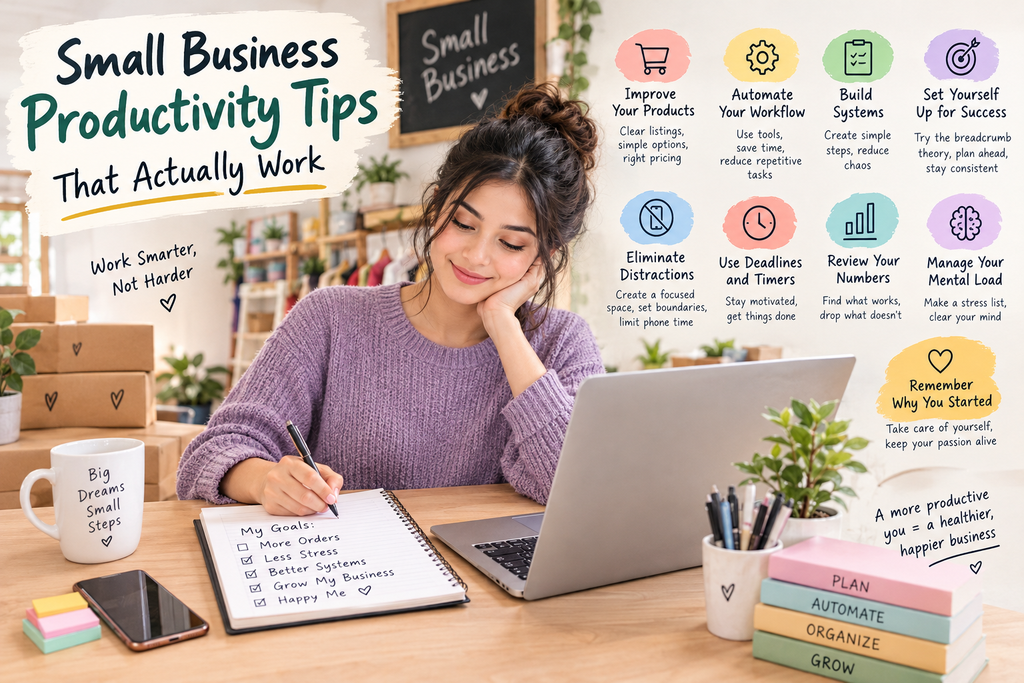
Small Business Productivity Tips That Actually Work
Let’s be honest. Productivity sounds boring. Burnout, stress, and mental overload are real problems. A lot of owners deal with them. However, it takes time and hard work to get better at handling them.
So if you’re busy all day but still feel behind, these small business productivity tips can help you manage your tasks more efficiently. They’re simple, real-life tips, and they actually work.
Ultimately, here’s the main idea. Productivity isn’t about working harder. It’s about designing your business so that it’s easier to run.
Start with Your Products: Small Business Productivity Tips for Your Shop
Make Your Listings Clear
One thing people don’t talk about enough is that productivity starts with your products. If your products feel confusing, your customers are probably confused too. As a result, that leads to chaos.
Good SEO, clear photos, and super detailed descriptions help a lot. They turn visitors into buyers. Moreover, they also stop those back and forth messages with customers. No confusion, no chaos. Ultimately, it just makes people want to buy.
Think about it from the customer’s side. Say someone can’t find the information they need in your photos or your description. They have two choices. They can walk away and find a different shop. Or they can message you. If they message you, you have to stop your workday to answer. As a result, that breaks your focus and cuts into your productivity.
So in short, clear listings do two things. Customers feel confident, so they’re more likely to buy. At the same time, you avoid the back and forth, so your workday stays uninterrupted.
Keep Your Products Simple
Similarly, another big one is keeping your products simple. You don’t need a million and one font choices. You don’t need 30,000 colors either. In fact, too many options cause decision fatigue for your customers.
And decision fatigue makes people feel chaotic. It makes your shop feel chaotic too. Consequently, it becomes chaotic for you, because you’re the one running the business. You’ll have so many choices to explain. You’ll have so many things to go back and forth about with customers.
So keep it simple. A good handful of fonts and colors is plenty. As a result, your customers will thank you, and so will your workday.
Price According to Your Labor
Another important factor is that pricing is also important. You don’t want every customer. You want the right ones. So price according to your labor, not just to get more sales.
In fact, too many sales can actually be a bad thing. That happens when you undercharge for what your product is worth. As a result, you end up buried in work that doesn’t pay you enough.
Therefore, try to find a good middle ground. Don’t charge too little. Don’t charge too much either.
You can also change your prices depending on how busy you are. Let’s say your products are in high demand and you’re swamped. In that case, you can raise your prices a little. On the other hand, if you’re in a slower season, it’s fine to price a bit lower.
Just don’t undercharge yourself. If you do, you’ll get more orders than you need. Furthermore, you’ll also attract customers who aren’t always the best type. Keep that in mind.
Automate Your Workflow
Why Automation Matters
Now, let’s talk about automation. It can completely change the game for a business. In addition, it can also change how you feel about your business. A healthy relationship with your work is a big deal.
Here’s a common story. An owner gets a heavy amount of orders. They’re juggling way too many balls. As a result, it all feels overwhelming, and they don’t know how to handle it. Some even think about quitting. At that point, something has to change.
Often the answer is automation and systems. Next, we’ll get to systems in a minute.
Here’s a simple way to know what to automate. Do you find yourself repeating yourself over and over? Is there a task that you have to do repeatedly, which takes up too much of your time? If so, then it probably needs to be automated.
Also, automation is not a lazy way out. It’s strategic. When you’re running a business, you need it. In fact, out of all the small business productivity tips out there, automation can give you some of the biggest wins.
Examples of Automation
Every business is different. Still, there are a few common examples. Mockup tools help. So do saved auto replies. Abandoned cart emails work well too. A good FAQ section is another great one. Basically, look for anything that saves you time.
Reply templates are a big one. Let’s say someone asks you the same question over and over. Maybe the answer is already in your description. They just missed it or didn’t read it. In that case, a template lets you answer quickly without typing it all out again. Additionally, you can use templates for all kinds of messages.
Mockup tools are another good option. Put all your fonts in one place. Then customers can browse the fonts, type in their choices, and look through colors. As a result, they don’t have to wait for you. And you don’t have to send every mockup by hand.
Save Hours Every Day
You need to find a way to cut down that daily fatigue. For example, imagine you spend over two hours a day just answering messages and sending mockups by hand. That’s a lot of time.
Now imagine you look into mockup tools and other automatic options. Customers can do things on their own. They don’t have to wait for you. As a result, suddenly you’ve cut out about two hours a day. That’s two more hours you can use to be productive.
So ask yourself a few questions. What do I do over and over again? What takes up a ton of my time? Could any of it be automated? In many cases, chances are there’s something out there that can help.
Sometimes paying for automation feels uncomfortable. You might even think it’s backwards. Why work so hard to make more money and then spend money? It’s a fair question. However, it’s cliche for a reason. Time is money.
Sometimes you have to spend money to save time. With that extra time, you can be more productive. You can be more creative. Moreover, you can also grow your business in a healthy way and keep a healthy mindset about it.
Build Systems: Small Business Productivity Tips That Cut Chaos
What Is a System?
You’ve probably heard of systems before. Business coaches and gurus love to talk about them. For a long time, many owners think, “I don’t really know what that is. I’m doing fine without it.” However, then they actually try it, and they see how important it is.
So what is a system? It’s a set of repeatable steps that you use in your business. The goal isn’t to make your to-do list longer. Instead, it’s to make things easier. That means fewer steps and less overwhelm.
A craft room is a good comparison. Picture a craft room with no labeled bins. All your tools and supplies are scattered in different bins around the room. You have a craft idea in mind, but you don’t know where anything is. As a result, you spend all your time searching instead of creating.
A system is the opposite of that. You know the steps you need to take. You know where everything is. Everything is easy to understand. And Everything has a home. Everything has a place.
That’s why you have to clear up your craft room. In other words, you have to clear up your mind too. Then, you can run things smoothly.
How to Start
A good way to start is simple. Sit down and write a list of everything you actually do in a workday. Don’t write what you should do. Instead, write what you actually do.
Next, write down how each task makes you feel. Think about your emotional state. You can use tally marks if that’s easier. Some things will drain you. And Some will give you anxiety. Some will just take too long. Write those down. That way, you know what needs work.
Here’s an example. Say you spend two hours a day sending customers mockups, back and forth and back and forth. You get 50 or more messages a day. That’s draining. More importantly, it’s also a broken part of your system.
So you fix it. You set up an auto reply that answers a bunch of common questions and your FAQ. That cuts out a lot of questions. Additionally, you add a mockup tool. Customers get their mockups quickly, and they don’t have to wait on you. That part of your day is gone. As a result, now you have more time to be productive and get real work done.
Yes, systems can sound like business lingo. However, give it a try. Sit down and look at your day. You’ll find broken parts, and they can be fixed. Once they are, your life gets so much easier.
Set Yourself Up for Success Every Day
Try the Breadcrumb Theory
Next, let’s talk about setting yourself up for success every day. You may have heard of the breadcrumb theory. If you haven’t, it’s a great one. It works really well for people who need help staying focused. Additionally, it’s good for anyone who likes small rewards too.
The idea is simple. You leave small, intentional setups for your future self. Those setups make tomorrow’s work easier. In fact, you do it every single day.
It looks a little different for each person. For example, here are some examples. You could clean up your workspace at the end of each day. Then you come back to a nice clean space. Maybe your tools are laid out and ready to go. You could pre-clean your machines so you can walk in and get started. You could finish up your emails. And You could set up the files you need for tomorrow. You could even design the next day’s orders ahead of time. That way, you just wake up and get to work. A little to-do list works too.
Those little breadcrumbs motivate you. You know what works for you. You know what inspires you. Therefore, do what fits.
This works in daily life too. For instance, plan a meal plan for the week. Then you don’t have to think about food. Write a to-do list. Mark things on your calendar. Basically, do things that in the future you will be thankful for. You’re just helping yourself out.
Eliminate Distractions
Why Distractions Hurt
Distractions can completely derail your workday. One distraction can change your whole day. If something throws you off, it messes with your attention span. Hours! That’s why distractions are one of the big things that kill productivity.
Here’s something important. If distractions keep winning, it’s not a willpower problem. It’s a design issue. Fortunately, design issues can be fixed. One of the most useful small business productivity tips is to cut out what pulls you away.
Ways to Cut Distractions
Start with where you work. Pick a specific spot for your workspace. Try not to use a main living area where people are around. Maybe you don’t work well around others. Maybe you need a space that isn’t for relaxing. Instead, make it strictly your workspace.
Next, deal with your phone. Put it away during work. Or set it to do not disturb, with only the important things allowed through.
Think about videos too. Maybe watching videos distracts you while you work. If so, try a podcast or some music instead. You have to find what pulls you away. Some things help you be more productive. Other things pull you off track. Therefore, figure out which is which for you.
Another great idea is to set office hours for yourself. That way, you’re not going back and forth with messages and emails all day. Pick a couple of times a day to check them. When you’re out working, it’s so easy to get pulled in by every email and message. As a result, setting aside a couple of times a day fixes that.
Here’s why this matters. Every time you switch tasks, your brain has to reload completely. That takes time and effort away from what you’re doing. Consequently, it lowers your productivity.
Yes, this might seem obvious. A lot of people say, “Duh.” Even so, it still kills productivity. So figure out when you’re most distracted. Then, take away whatever causes it. That’s how you stay productive.
Use Deadlines and Timers
Deadlines help a lot of people. Small tasks and little challenges can be very motivating. Furthermore, they work in both business and personal life.
Try saying something like this to yourself. “I’m going to respond to messages for 20 minutes and see how many I can get done.” Alternatively, try this. “My laptop battery is at 50%, so I’ll design orders until it dies.”
As a result, that can be super productive.
Review Your Numbers Every Week
At the end of each week, look at your stats. Figure out what made money. Figure out what saves time. Also, figure out what felt like a waste of energy.
Don’t get me wrong, trying new things is very important in business. However, there’s a time and a place for it. If you’re working on your productivity, you need to find what’s working. Then, double down on it.
Here’s a good test for any task. Does it make money?Or Does it save time? Does it support future sales? If not, the answer is no to all three, it might be time to cut it.
So take the time to do this review. Look at your stats. That way, you make more space for productivity.
Manage Your Mental Load with a Stress List
Here’s a simple tool called a stress list. Write down what is stressing you out for the month in a notepad in your phone.
This could be something very simple such as scheduling a dental visit. Alternatively, it can be something big, like doing taxes. It doesn’t even have to be about business.
Believe it or not, those little things take up a lot of mental load. They also use up energy. As a result, you may be thinking about them all the time throughout your day.
Now and then, you’ll get the urge to knock something off that list. It feels so good to cross things out. In addition, it also boosts your productivity. This is one of the easiest small business productivity tips to try.
So try it for a month. Make your stress list. Write down what’s stressing you out. Add the things you want to get done this month. However, don’t stress if you don’t finish everything. At least you wrote it down. Now, you’ve got the mindset to get it done. That’s the first step. You just have to start.
It’s crazy how much mental energy stress can take up. Therefore, make a stress list and see how it goes.
Remember Why You Started
When you’re burned out and stressed, it’s easy to forget why. As a result, you can forget why you started the business in the first place.
Extreme stress can lead to burnout. Burnout can make you think you don’t want to do this anymore. However, often the real problem is something else. You may just need better systems. Also You may need automation. You may need help.
So if you’re going through that, remember your why. Then, fix the broken systems that are in your way. That helps you be more productive. As a result, you can get a lot done.
Also, take time for yourself. Don’t work all the time. Set working hours. Spend time with family. Do things you love. Create for fun too. Make something just for yourself. Don’t only make things for other people to buy.
Final Thoughts on Small Business Productivity Tips
Productivity isn’t about squeezing more out of yourself. Instead, it’s about building a business that supports you. And you don’t have to fix everything at once. It takes a lot of time.
Start small. Pick one thing to change. Maybe clean up your product listings. And Maybe add automation. Maybe start a stress list. With these steps, these small business productivity tips can help your daily orders go from overwhelming to just part of the routine.
It’s amazing what happens when you take time to improve your productivity. Orders that once felt stressful can become normal. That’s because you set up systems that make things easier, better, and more productive.
