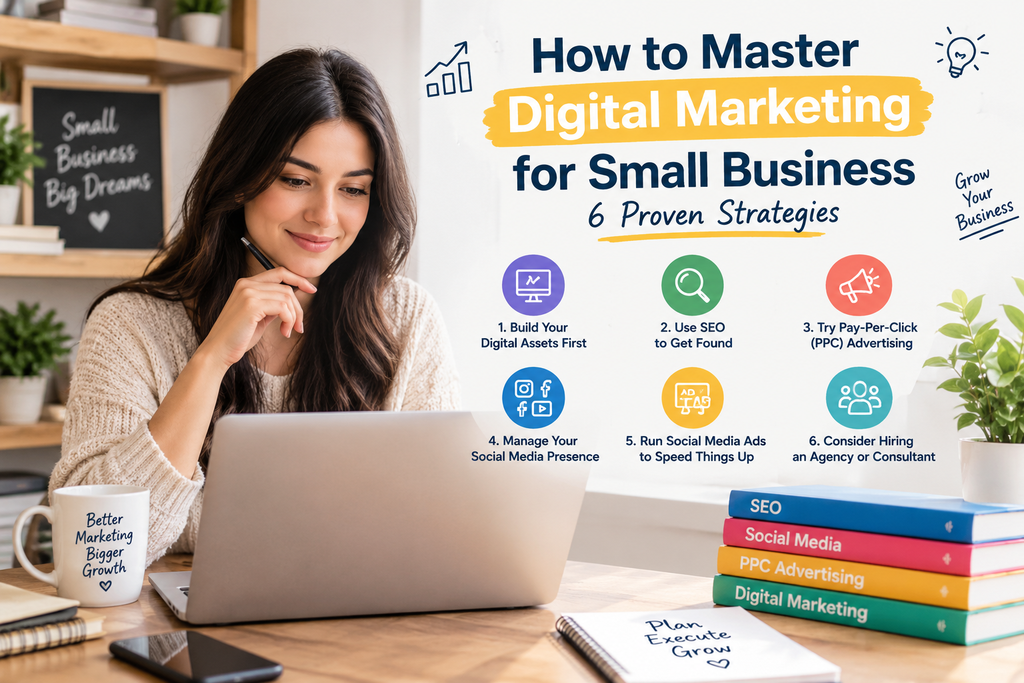
Digital marketing for small businesses can feel overwhelming at first. So much advice competes for your attention. However, six strategies stand out as the real foundation for results. These aren’t just theories, either. In fact, professionals tested them for years. And they still work today.
1. Build Your Digital Assets First
Before you spend a single dollar, get three things in place. First, build a website. Second, set up an email drip sequence. Third, gather high-quality photos and visuals.
Why does this matter? Because these assets work together. For instance, your website gives people a place to find you. Meanwhile, your drip sequence follows up automatically. And your visuals create a strong first impression.
Here’s the catch, though. All three need good design. Otherwise, no matter how great your message is, people won’t trust an outdated look. So, invest in design quality early. As a result, it pays off later.
2. Use SEO to Get Found
Think of SEO as the biggest mall on the internet. People go there to search for solutions. So, if your business doesn’t show up, you’re missing ready-to-buy customers. This is a core part of digital marketing that too many small businesses skip.
Getting started takes three steps:
- Keyword research. To begin with, tools like Google Keyword Planner show you what people search for, along with monthly volume.
- On-page optimization. Next, optimize your meta tags, alt tags, and headings. Plugins like Yoast SEO , Google SEO Starter Guide make this easier, even for beginners.
- Patience. Above all, SEO takes time, usually six to twelve months. Don’t expect overnight traffic. Instead, stay consistent and keep improving.
3. Try Pay-Per-Click (PPC) Advertising
If SEO is the mall, PPC is like renting prime retail space at the entrance. You pay for visibility. However, you get results much faster than SEO.
To succeed, keep three things in mind:
- Do your keyword research, just like with SEO.
- Watch your click-through rate (CTR) closely, since it affects your traffic.
- Optimize your landing pages. A simple page with one clear call-to-action converts better than a cluttered one.
Remember, PPC gets you fast traffic. But it also cuts into your profit margins. So, plan your budget carefully before diving in. Within any digital marketing mix, PPC works best as a short-term boost, not a long-term crutch.
4. Manage Your Social Media Presence
Social media works differently than SEO. People aren’t searching for products there. Instead, they’re looking to connect with friends and family. Therefore, the intent is completely different.
That means you can’t just push sales messages. Instead, focus on two things:
- Listen first. Join relevant groups, read comments, and understand your audience’s challenges.
- Create valuable content. Share things that genuinely help, not just promotional posts.
Also, don’t underestimate consistency. Posting often matters just as much as posting well. In fact, brands that post frequently tend to see stronger organic growth over time.
5. Run Social Media Ads to Speed Things Up
If social media is like a park, ads are like setting up a booth there. Not everyone will stop by. Still, the right ad can drive serious results.
A few tips for effective ads:
- Lead with value, not a sales pitch.
- Write strong headlines first, since people read those before anything else.
- Use emojis strategically to capture emotion.
- Always use high-quality images and visuals.
One advanced tip: warm audiences convert far better than cold ones. So, if you can retarget past visitors or customers, you’ll likely see stronger results. This tactic alone can sharpen an otherwise scattered digital marketing plan.
6. Consider Hiring an Agency or Consultant
Digital marketing has a lot of moving parts. So, if you lack the time or expertise to manage it all, hiring help makes sense.
When choosing between a consultant and an agency, remember that agencies typically offer more stability. After all, a single consultant can get sick or move on. An agency, on the other hand, has more backup and continuity.
Either way, prioritize experience over price. Furthermore, avoid handing your marketing to inexperienced interns. They may bring enthusiasm, but they often lack the judgment needed to guide real strategy.
Final Thoughts on Digital Marketing for Small Business
These six strategies form a solid foundation: build your digital assets, use SEO, try PPC, manage social media, run social ads, and consider professional help when needed. Ultimately, if you approach digital marketing with patience and consistency, the results will follow.
