
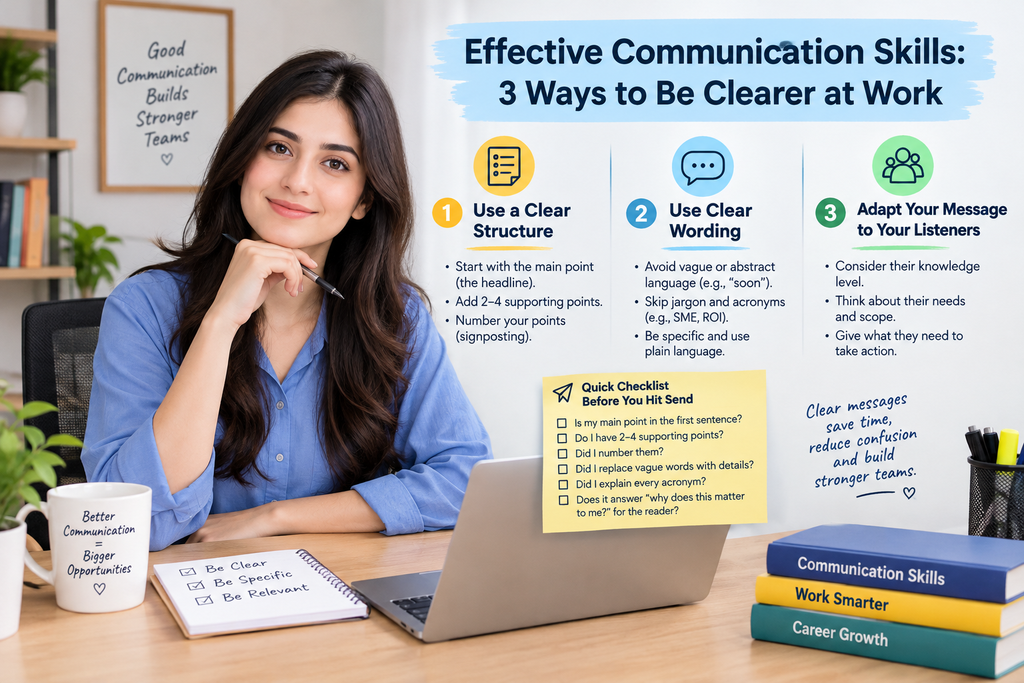
3 Ways to Be Clearer at Work
Ever left a meeting unsure what was actually decided? Or read an email twice and still missed the point? That’s rarely your fault. It’s a clarity problem. What prevents people from developing effective communication skills at work is often a lack of clarity.
Fortunately, there is a quick solution to that. Utilize the technique while monitoring your statuses, sending emails, and having important talks.
Andrew Grove, the former CEO of Intel, wrote about this in High Output Management. His point was simple. How well we communicate isn’t about how well we speak. It’s about how well we’re understood. So the real test sits with the listener, not the speaker.
Clear messages save time. People don’t have to guess. They can respond right away.
1. Use a Clear Structure
Clarity begins by arranging what you have said. Poor arrangement is an easy mistake to make. The main point hides in the middle. Ideas jump around. The speaker works out their meaning while talking.
That leaves the listener with a job. They have to sort everything out on their own. And if your audience must solve your message like a riddle, it’s already unclear.
Luckily, there is a fast way out. Apply this method while checking statuses, writing e-mails, and during vital conversations. Good structure is the base of effective communication skills.
Start With the Headline
Put your main point first. Some people call this the bottom line. Say it right away. Nobody should wait to learn what you really think.
Compare two openings. The first: “After reviewing the numbers, the vendor options, and the timeline, I think we should consider a change.” The second: “We should switch vendors.” The second one wins every time.
Add Two to Four Supporting Points
Keep these tight. In a short message, one sentence each is enough. For a longer update, add a little detail to each point. Don’t go past four, though. Beyond that, people lose the thread.
Number Your Points Out Loud
Say “first,” “second,” and “third.” This is called signposting. Many people skip it. But it might be the most productive one to take. It keeps listeners oriented, and it makes you sound prepared.
Here’s what it looks like. “The project is on track to launch on May 15th. First, the design mockups were approved last Friday. Second, the lead developer is fully up to speed. Third, the budget looks steady at about $8,000.”
See how easy that is to follow? The answer comes first. The proof comes after.
Not every message brings good news, of course. Still, structure helps even more when the news is hard. It lowers the mental load on your audience. Research also suggests that people lean on the big-picture message to make sense of the details.
Try a quick check. Think of the last confusing meeting or email you dealt with. How much of that confusion came from blurry structure? Probably more than you’d expect.
2. Use Clear Wording
Unclear wording fails in two ways. Using clear wording is an essential part of effective communication skills because it helps people understand your message without confusion. They look like opposites. Yet they share the same cause.
Vague or Abstract Language
Some words feel clear to you. They may mean something else to your listener. We assume others picture what we picture. Usually, they don’t. A study published in Psychological Science found that speakers consistently overestimate how clearly they’re understood.
Here’s a common case. You ask a colleague when they can send a file. They say, “Soon.” What does that mean? For you, it might be within the hour. For them, it might be the end of the month.
“Can you take care of this?” has the same issue. Does it mean a phone call? A full report? A quick reply? This kind of phrase presupposes common knowledge. That understanding rarely exists. That is why people make their own assumptions, and often get it wrong.
It’s easy to fix. Just before sending a message, ask yourself the basics: What? Who? When? Where? Why? How?
Picture a poster for an event. “Come hang out sometime” brings nobody. A date, a time, a location, and things to bring will draw a crowd. Your work messages deserve the same care.
Here’s a quick before and after.
Before: “Can you look into this when you get a chance?”
After: “Can you check the sales report for errors and send me your notes by Thursday at 3 p.m.?”
Same request. Far less guessing.
Too Much Jargon
On the other hand, there’s jargon. It is characterized by an excessive use of abbreviations, acronyms, and jargon. Your readers will have a difficult time understanding your ideas. Decoding is difficult.
Acronyms add to the problem since they have many meanings at times.SME can mean subject matter expert. It can also mean small and medium-sized enterprises. KPI might stand for key performance indicator or key process indicator. Those are close, but they aren’t the same.
ROI may be the most overworked of all. It can mean return on investment, initiatives, information, or individuals. Say it in a meeting, and half the room starts guessing. Meanwhile, they stop hearing the rest of what you say.
Vague words and jargon look different. Their damage is identical. Each one opens a gap between what you said and what the other person understood.
The cure is plain language. Choose words that need no interpretation. Swap “soon” for “Friday.” Swap “SME” for “subject matter expert.” If the listener is new, explain the term once. That’s enough.
3. Adapt Your Message to Your Listeners
Has a message ever landed well with one group and flopped with another? It happens often. The reason is simple. Strong communication fits the real people in front of you. It doesn’t fit a generic listener you imagined.
Adapting is one of the most valuable effective communication skills to practice. Every listener quietly asks, “Why does this matter to me?” They want to learn something, or they want to know what to do. If you skip the tailoring, they’ll keep wondering.
You can adapt in three ways.
Knowledge level. Are you talking to an expert or a non-expert? Experts want you to skip the basics. Too much background frustrates them. Non-experts need that context to follow along.
Scope. Executives usually want the big picture and what it means for the business. They’ll ask follow-up questions if they need more. A frontline manager leading a team wants something else. They need concrete details, specific information, and clear next steps.
Needs. What does your listener need from you? If they must make a decision, give them options, trade-offs, and a recommendation. If they’re there to learn, give them explanations and examples. Then let them apply what they’ve learned.
One Message, Two Audiences
Imagine a project is running late. Here’s how the same news might sound to two different people.
To an executive: “The launch moves from May to June. Costs stay the same. I need your approval on the new date.”
To a team lead: “The launch is now June 12. Your team needs to finish testing by May 30. I’ve updated the task list.”
The facts match. The focus doesn’t. Each listener gets exactly what they need to act.
Whatever you share, look at it through your listener’s eyes. Then translate the message for them. The goal is to cut down the work they must do to understand what’s in it for them.
A Quick Checklist Before You Hit Send
Use this short list before any email or meeting.
- Is my main point in the first sentence?
- Do I have two to four clear supporting points?
- Did I number them?
- Did I replace vague words like “soon” with real dates and details?
- Did I explain every acronym?
- Does this message answer “why does this matter to me?” for this reader?
If you can say yes to all six, your message is in good shape.
Final Thoughts on Effective Communication Skills
Clear communication isn’t about sounding smart. Open your next email with the main point. Replace one vague word with a real date. Then think about who will read it before you hit send. Your message is only as good as the understanding it creates . People ask fewer questions. Meetings run shorter. You also spend less time fixing misunderstandings.