
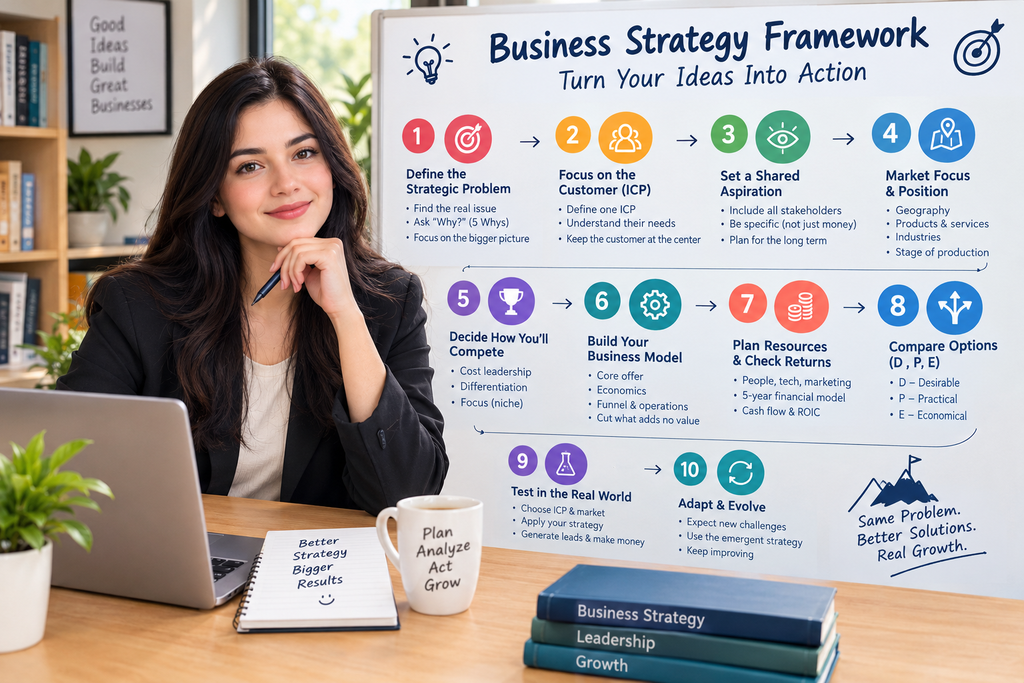
Business Strategy Framework: A Practical Guide to Define, Test, and Scale
The common perception is that strategy is something complex. It isn’t. A good strategy formulation framework will break it down into a few key questions, which when answered sequentially will make the process much easier. This manual will lead you through all of the stages starting from defining your basic problem to conducting field tests of your solution. A good business strategy framework helps you identify your biggest business challenges, understand your ideal customers, and develop practical solutions for long-term growth.
Why a Scientific Business Strategy Framework Works Better
There are two ways to think about strategy. One is the business approach. The other is the scientific approach.
The business approach is crowded. Mission, vision, and values. SWOT analysis. The 7 S’s. The five Ps. EOS. Each year sees the emergence of another one which is the flavor of the day. While all seek to instill strategy, they are all inadequate and fail to make an impact by themselves.
The scientific approach is simpler. You start with a problem. You form a hypothesis about how to solve it. Then you run experiments to see if you were right. That’s it. This framework for business strategies takes each step precisely in that direction.
Step 1: Identify Your Problem with a Business Strategy Framework
Everything starts here. The strategic problem is the number one constraint in your business. It’s the single obstacle standing between the company and the results it wants.
Picture the owner and the team heading toward a dream outcome. Along the way, there are dozens of obstacles. It can feel like everything is a problem. But you can’t fix everything at once. Choose one wall – the one that means the most. Name it because it must be named if you are going to claim it. Then solve it.
Here’s the catch. Once you solve that problem, another one shows up. You get a little closer, and a new wall appears. That’s normal. Strategy is iterative, so don’t expect a finish line with no surprises.
Skipping this step is expensive. Imagine a leadership team that spends hours drawing an org chart and assigning responsibilities. Then they list 30 priorities and cut them down to five. It looks productive. But nobody ever asked what problem they were solving. Without that answer, the five priorities are just guesses. Commit to action before defining the problem, and you build a strategy on the wrong foundation.
One more thing. The strategic problem is not about a single customer’s order. It’s bigger than that. It’s more macro, closer to the health of the whole business.
Ask Why Five Times
How do you find it? Ask why. Then ask again. Think of a child who keeps asking “Why?” until you run out of answers. It’s annoying at home, but it works well in business.
Say the first answer is “We’re struggling with cash flow.” Why? Because revenue is dropping. Why? Because there aren’t enough leads. Why? Because the offer is weak, the funnel isn’t strong, and there’s no real lead generation engine.
Now you’ve gone from a vague symptom to a real, fixable problem. You might not need exactly five whys. Some issues may appear in threes, while some may appear in sixes. It all boils down to digging deeper until you hit the root cause.
Spend real time here. If you get this step right, everything after it flows naturally. And no, strategy isn’t a mysterious black box. It’s quite simple when you start from the right place.
Step 2: Use Your Business Strategy Framework to Focus on Customers
Every strong business strategy framework puts the customer in the middle. It sounds obvious. Yet it’s surprising how often it gets forgotten.
Picture a full day of executive presentations about next year’s plans. Revenue targets, new hires, product ideas. And not one person mentions the customer. It happens more than you’d think. When strategy work begins, many teams slip into “me, me, me” thinking. What do we want? How do we see things going? The customer disappears from the conversation.
Flip that around. Begin with the customer in mind. This is when you determine what your ICP is, your ideal customer profile. Creating an ICP needs its own set of instructions, so we will keep it simple here.
The key rule is simple: define one ICP. Not two, not five. It’s tempting to create several customer profiles and avatars, especially when you want to serve everyone. But going broad adds complexity fast. Pick one ICP and focus your strategy on solving that customer’s problems. You can always expand later.
Step 3: Set Goals for Your Business Strategy Framework
Now ask a different question. What does winning look like?
The word “shared” matters here. Everyone must be involved: ICP, staff members, suppliers, shareholders, and the entire community. Basically, every stakeholder your business touches. When all of them can see and support the same vision of winning, your strategy gets much stronger.
Be careful about defining winning only in money. Saying “we want to be a $100 million company with 20% margins” isn’t wrong. But it flips the logic. Money is a result. A good strategy drives financial results, not the other way around.
So get specific about what winning means in practice:
- Do you want to grow the business as large as possible?
- Do you want to sell it one day?
- How do you like to approach the future with respect to the team and clients?
Avoid the use of vague and cliché words. Even though the term “aspiration” is rather lofty, this stage requires clarity of thought. Insightfulness takes a back seat to clarity at this point.
Step 4: Select Market Positioning and Target
Market focus and position sounds like jargon. It really isn’t. It just answers one question: where will your company compete?
That can include geography, products, services, industries, and the stage of production.
A house-hunting example makes it easy to understand. When you buy a home, you don’t pick randomly. You consider the school, the time taken to commute, the neighborhood, even the trees along the way. Your future is determined by such considerations for many years to come. That is how market positioning works.
Why does it matter so much? Because the wrong position makes winning very hard, even with a great plan. Try rolling out a premium service in a remote town with no real customer base. The strategy might be excellent, but your ICP simply isn’t there. For example, Walgreens and CVS have their stores on the corners of intersections. Location is very important in terms of real estate, and it’s also very important for positioning.
Work through these four areas:
- Geography: In which field are you planning to participate – local, state, regional, national or international?
- Products and services: What will you offer to serve your ICP?
- Industries: Which industries will you focus on?
- Stage of production: Will you make the product from raw materials, or have someone else produce it while you white label it?
Keep returning to your ICP as you answer. Every choice should serve that one customer.
Step 5: Choose a Competitive Strategy for Your Business
Competitive behavior is a fancy way of asking how you’ll compete. According to Michael Porter, there are three generic strategies.
Cost leadership. Think about Walmart or Amazon. Thanks to their efficiency, automation, outsourcing, and economies of scale, their cost structure is very low. This makes it possible for them to sell cheaper products without reducing margins.
Many people push back here and say they don’t want to be the cheapest. Fair enough, but cost leadership isn’t about being cheapest on price. It’s about your cost structure, meaning how much it costs you to deliver the product or service.
Differentiation. Think Chanel or Prada. They stand apart from competitors, and because they’re different, they can charge premium prices. It’s why someone will happily pay more for a Louis Vuitton purse than for a similar one at a big-box store.
Focus. This one can blend the other two, but it mainly comes down to a niche. You get very narrow with your ICP and solve their problems better than anyone else. The riches really are in the niches.
Build Your Business Model
Picking a generic strategy is only half the job. Next, you need an overall business model.
Start with your core offer. Then work out its economics. Say you charge $500. Now ask what it costs to win and serve that customer in the first 30 days. If the answer is $1,500, you have a problem. You’ll burn through cash quickly, and no amount of marketing will fix it.
Do the same exercise for the funnel and the full operating model. Then look at every activity the company performs. Why are you pulling that report? Why does this process exist? If an activity adds no value for the company or the customer, cut it. Getting into the DNA of the business like this shows how products and services are really delivered.
Step 6: Plan Resources and Returns
By now you’ve defined your shared aspiration, your market focus, and your competitive behavior. The next question is practical: what do you need to make it happen?
Maybe it’s a strong business development, sales, and marketing team. Maybe AI has to become a core capability. Maybe you need your own tech stack or app. Write the full list down.
Then build a financial model. This is where the business strategy framework meets finance, and it’s the step many people skip or do poorly.
Your model should project cash flow over the next five years and beyond. It should also estimate the value of the business under this specific strategic option. Two checks matter most. First, does the company have enough cash to hire the people and put the technology in place? Second, does the return on invested capital (ROIC) justify the whole effort? If the numbers don’t work, the plan needs to change.
Step 7: Compare Strategic Options with D, P, and E
Here’s something people often miss. Everything in steps 2 through 6 is just one option. In reality, you run that whole process several times, once for each strategic option.
The strategic problem never changes, though. You’re solving one problem in several different ways. You’re not trying to fix three different problems at once, which would only add complexity.
Some example options might look like this:
- An M&A strategy, where you buy several companies and roll them into one
- A joint venture with another company
- Organic growth, followed by a sale down the road
Run each option through the same business strategy framework. Then score it with D, P, and E:
- D, Desirable: Do we actually want this?
- P, Practical: Can we realistically pull it off?
- E, Economical: Do we have the cash and capital?
Take the M&A option first. It’s very desirable. On practicality, it’s a maybe, since the company has never done it before, although the right hires could help. Economically, it fails. There’s no cash flow and no access to capital. So this option probably isn’t viable.
Now the joint venture. Is it desirable? Unclear, because the partner might take your ideas. Practical? Also unclear. Economical? Yes. Overall, it doesn’t look great.
The third option is desirable, practical, and affordable. That’s your winner. But you’re still not finished.
Step 8: Test Your Business Strategy Framework in the Real World
A winning option on paper is still just a hypothesis. Don’t bet the entire farm on one strategy session with your team.
Go out and test it. Choose your ICP and your market. Apply your competitive behavior. Try to generate some leads. Make your offer and see whether you can actually make money with it. You’ll learn quickly whether the idea holds up.
One last idea worth remembering. What you plan is your intended strategy. It’s what you draw on the whiteboard with your team. But once you execute, something different appears: an emergent strategy, shaped by what really happens. Expect it, and use it.
Final Thoughts on the Business Strategy Framework
A good business strategy framework is simple. Find one strategic problem. Build around one ICP. Define a shared aspiration. Choose your market focus and position. Decide how you’ll compete. Plan your resources and check the returns. Then compare your options with D, P, and E, and test the winner in the real world.
That’s how you design a strategy. Turning it into daily action is the next challenge, and it needs its own playbook. Start by identifying one major business problem, then choose one practical solution to test. Review the results, learn from customer feedback, and adjust your strategy as your business grows.

