
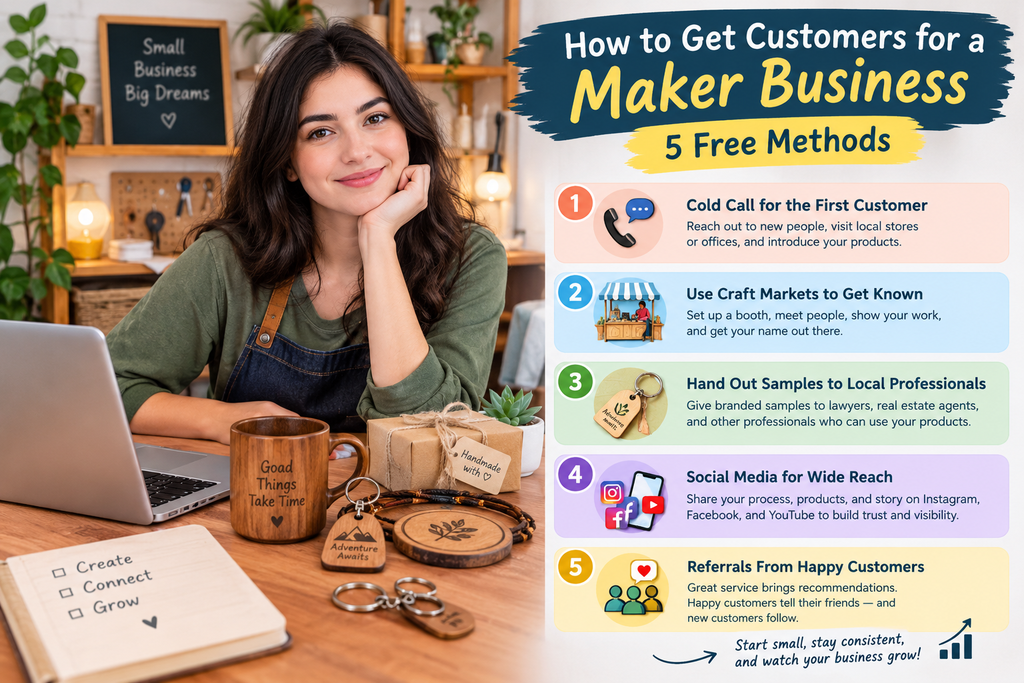
5 Free Methods
The workshop is ready. The tools are set up. The products look great. But nobody is buying, because nobody knows you exist. That is the real problem for most new makers, and it is a bigger one than making the product itself. This guide shows how to get customers for a maker business with five practical methods. Most of them cost little or nothing.
Finding buyers is hard. It is probably the toughest part of running a business, and most makers are not naturally good at it. That is all right. This is an acquired skill. Each technique mentioned below is a progression of the previous one. Therefore, you may begin with the first one and work your way down.
Method 1: Cold Contact for the First Customer
Cold contacts are those in which you get in touch with people who have never heard about you before. For instance, you could call someone who has never heard of your business and may not be interested in your offer. Alternatively, you could just go into a store or office and tell them what you are selling.
It sounds terrifying. It is also difficult. Cold contact can be challenging, and many conversations will not result in a sale. However, it can help you reach your first potential customers when you have no existing customer base. These statistics may seem discouraging. However, this is where most producers start from. You have no presence yet and no customer list, so a little cold contact is how you get that first sale.
Use Craft Markets to Get Known
Makers have a small advantage here. Marketplaces are a wonderful way of making friends with strangers. Rent a table for a weekend and bring your products. Your goal is not to push a sale. Your goal is to meet people, say hello, and get your name out.
Everyone walking through that market came to meet makers and maybe buy something. They just do not know who you are yet. So invite them over as they pass your table. Show them what you have. Mention that you can build custom pieces too. Craft markets can also help you meet potential buyers, demonstrate your products, and build relationships that may lead to future sales.
Do not worry about profit at this stage. Getting known and winning your first few customers is the whole point.
Hand Out Samples to Local Professionals
A real example makes this easier to picture. Say you want to sell logoed items to a lawyer or a real estate agent. These professionals use such items all the time, so your product already fits their day.
Start by making five or six keychains. Add their logo, name, and contact information to every piece. They should be packed in a box just like an actual order because first impressions are crucial. Then take the box to their office. Tell them you have created some samples, invite them to try the keychains, give them your business card, and let them know you will follow up in a couple of weeks.
There is a small cost. Keychains are cheap, though, often around a dollar each. In addition, the products offer the consumer tangible evidence for themselves to try, unlike sales pitches alone ever do.
Method 2: Warm Contact for Better Odds
Warm contact is different, because it does not start from the unknown. It usually begins in one of two ways. It is the natural second step in how to get customers for a maker business, since it uses people you have already met.
The first way involves people you have already talked to. They showed some interest but said “not right now.” A few weeks later, you get in touch again. They liked what you did once, so your chances of closing the deal are much better.
The second way involves existing customers. Go back to that lawyer and ask for help. Tell them you are looking for more business and ask whether they know anyone who might want what you make. Sometimes they will give you names. In many cases, the lawyer has already shown your keychains to a few people, and some of them said they were interested. The lawyer then connects the two of you.
The numbers improve too. Warm contact can improve your chances because these people already know you or have shown interest in your products. It costs less as well. These people already know what you do, or they have seen your work at a craft fair, so there is little to explain. Deals tend to close fast.
Method 3: Social Media for Wide Reach
Social media is the third method. However, free options such as Instagram, Facebook, and YouTube can expose your works to the entire world. You build trust and relationships online. It is far less personal than a handshake, but you can reach many more people in much less time.
Try a Reel or a YouTube Short. Show your company, your process, or a finished product. Then link everything back to your contact information.
Social media works best for brand appeal. The message is “look at my company,” not only “look at this coaster I built.” You can post without any big plans, too. Share things you have made, whether for customers or as experiments with a new product. Some viewers will message you to say they want one. Others will ask for something similar but different.
Think of it as putting up your hand and waving. You are saying, “My company is over here.” That small act of being visible pays off over time.
Method 4: Referrals From Happy Customers
Referrals are the strongest answer to how to get customers for a maker business over the long run. They do have one downside. You need a fairly solid customer base first, because referrals depend on people recommending you.
Here is how it works. A customer shows a friend something you made. The friend says, “I want one of those too.” The customer points them your way. You paid nothing for that lead, apart from keeping the first customer happy.
The best part is trust. The new customer arrives with trust already built in. They trust their friend, so they trust you. Referrals can be valuable because potential customers often hear about your products from people they already trust. However, not every referral leads to a sale. The referred customers are usually loyal too and return with their orders.
This is why it pays to spend real time on every single customer. Each happy buyer can bring in the next one.
Method 5: Paid Advertising to Save Time
Paid advertising is the fifth and final method. If alarm bells are not going off already, they should be. The word “paid” is right in the name, so a lot of money can be involved.
In simple terms, you are paying to reach potential customers through advertising. You could use a platform like Google Ads or hire a marketing professional to manage your campaigns.
The upside is clear. It frees up a lot of your time. If you are weak at sales, you can bring in an expert. The downside is just as clear. It can get expensive fast.
A business-to-business model is another route. You sell wholesale to a company that handles the advertising, and they keep a cut. Either way, you are spending money to save time.
Watch your budget. A few hundred dollars does not go far in the advertising world. It may bring in some new customers, but once you do the math, you could end up barely breaking even. Results vary. Paid ads make more sense later, when you have steady revenue and very little spare time.
Etsy is another example. You create listings, and the platform advertises them and brings buyers to you. Etsy charges sellers several types of fees, which may include listing fees, transaction fees, payment processing fees, and optional advertising costs. Check Etsy’s current fee policy and calculate your total costs before deciding whether the platform is profitable for your business.
Do the math first, then decide whether paid advertising is right for you.
Which Method Should You Start With?
If you are wondering how to get customers for a maker business with no budget, start at the top of this list. Begin with cold contact and craft markets. Move to warm contact once you have a few conversations behind you. Add social media alongside both, since it runs quietly in the background.
Referrals will come on their own as your customer list grows. Paid advertising can wait until you have the revenue to test it safely. Here is a simple way to see the path:
- No customers yet: cold contact and craft markets
- A few leads: warm contact and follow-ups
- Some work to show: social media posts and short videos
- A solid customer base: referrals
- Steady revenue and little time: paid advertising
Mistakes to Avoid When Learning How to Get Customers for a Maker Business
Most failures in how to get customers for a maker business come from giving up too early. Cold contact feels bad when the first ten say “no.” That is completely normal. Remember that a 2% conversion rate means most conversations will not result in a sale.
Another common error is trying to sell something during each discussion. At a craft market, you are there to meet people. Sales come later. A third mistake is skipping follow-ups. Someone who says “not right now” is often a future customer, so reach out again.
Finally, do not go for paid advertisements too quickly before understanding what works. Test the free methods first. They teach you what your customers care about, and that makes any paid campaign far more efficient later.
Final Thoughts on How to Get Customers for a Maker Business
These five methods run from “I have no customers at all” to “I earn enough to pay someone else to manage my customers.” Start small. Meet people in person, follow up with those who have shown interest, post your work on the web, satisfy all customers, and use paid advertisements if figures favor doing so.
Dozens of other sales models exist, and a good marketing book on sales can teach you more. For most makers, though, these five are the most useful. Put them to work, stay consistent, and you will have a clear answer to how to get customers for a maker business.

