
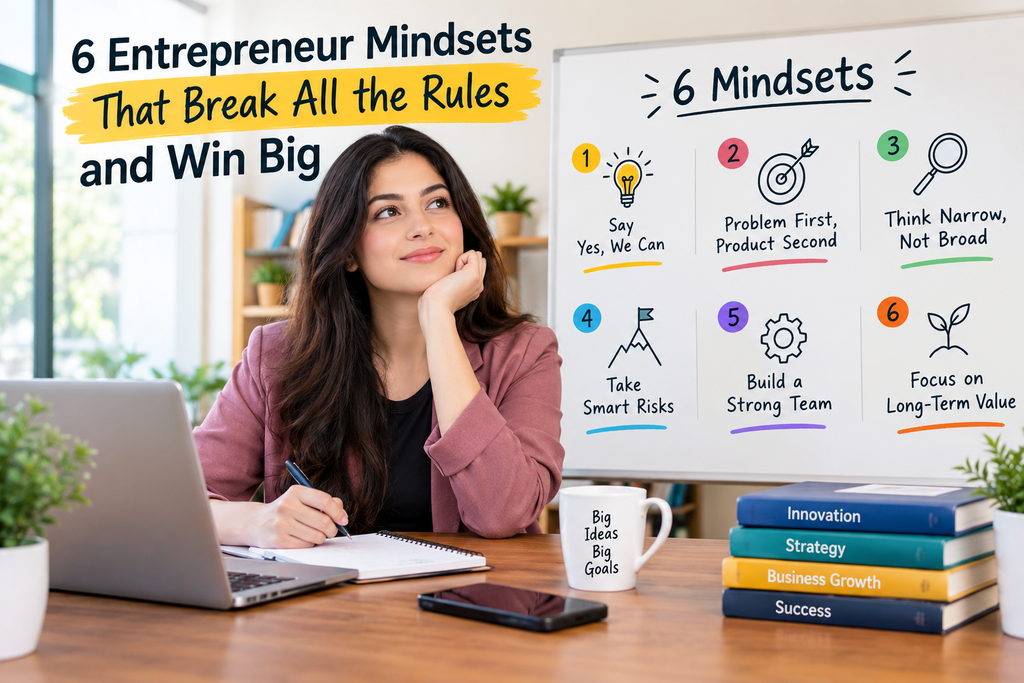
Entrepreneur Mindsets That Break All the Rules and Win Big
Most big companies play it safe. They follow a playbook, repeat what worked last year, and say no to anything that looks unfamiliar. Founders don’t work like that, and it shows. This article walks through six entrepreneur mindsets that go against standard business advice, with a real company behind each one. Some of the results are surprising.
How Lynda.com Got Started
Lynda Weinman was a graphic design teacher in 1995, and she had a side dream of building a business. She registered Lynda.com for a simple reason. She wanted a sandbox where she could play with the new design tools of the time, like Photoshop and Illustrator. Her students also needed a spot to show off their work, and a website did that job well.
The site grew. By 2002 she could see it had real potential, so she moved all her teaching online. LinkedIn later bought the business and renamed it LinkedIn Learning, for 1.5 billion US dollars. That’s a long way from a sandbox. It’s also a good example of counterconventional thinking, and the rest of this article builds on it.
Why Are These Entrepreneur Mindsets Counterconventional?
Because they cut against what big companies call best practice. They also clash with a lot of what business schools teach about strategy, marketing and risk. That’s the point. These ideas work precisely because large firms avoid them.
What a Mindset Really Is
Think of a mindset as your default reaction. It’s the mix of attitudes, habits and thoughts that decides what you do when something lands in front of you. For founders, that something is usually an opportunity. Two people can see the same opportunity and respond in opposite ways, and the mindset is the reason. The six entrepreneur mindsets below show where founders and big companies split.
Entrepreneur Mindsets 1: Say “Yes, We Can”
The “Stick to Your Knitting” Rule
Business school strategy 101 is blunt about this. Work out what you’re really good at. These skills make up your competencies. Build them up, use them, and guard them. If the customer asks for anything outside of those limits, the proper reaction is to politely decline the request. “Sorry, we don’t do that here.”
Arnold Correia and Atmo Digital
Arnold Correia, a Brazilian entrepreneur, ignored that rule and built what’s now called Atmo Digital. He had already reinvented his business twice and was running a major event management and production company. Then a customer came to him with an odd request. This customer had 260 stores spread across Brazil, which is a huge country, and wanted to broadcast training and motivational events to every one of them in real time. Could Arnold install televisions in each training room? Could he build a satellite uplink to feed them?
He said yes. He knew nothing about satellite technology. He’d never worked outside São Paulo. He got it done anyway.
A few years later, Walmart, one of his customers, came up with a new idea. The screens were sitting in the back rooms of its stores, so why not move them onto the sales floor and sell advertising? A shopper in the detergent aisle could see a Procter and Gamble ad right where they were standing. Arnold’s answer was the same. Yes, we can do that.
He rebuilt his business from scratch four different times through the years. Every time, a customer asked him to do something that was out of his comfort zone, and every time he agreed.
Entrepreneur Mindsets 2: Problem First, Product Second
Where Product Thinking Goes Wrong
Within a large corporation, all eyes are on the product. For example, in laundry detergent, a new brand manager arrives and changes the formula. The blue speckles turn green. The box now says “new, improved.” Is that innovation? Hard to say yes.
Coca-Cola went through something similar. Classic Coke came first, then New Coke, which flopped. After that came Diet Coke, Coke Zero, Vanilla Coke and Cherry Coke. Lots of Cokes. Not much that’s truly new.
Jonathan Thorne and the Sticky Forceps
Founders flip this around. They start with a problem and work backward. Jonathan Thorne did exactly that.
Almost every surgeon, in every specialty, relies on surgical forceps. They have one annoying flaw, though. They stick to human tissue. Picture a plastic surgeon finishing a facelift while the tissue clings to the tool. The result might not look as good, the surgeon gets frustrated, and the operation drags on.
Thorne thought he could fix that with a new silver-nickel alloy he’d developed. The plastic surgery market turned out to be small, and growth was slow. So he went looking for a specialty with a bigger version of the same problem. He found neurosurgeons, who work on the spine and the brain. Nobody wants tissue sticking to a tool in there.
He built a fantastic business and sold it to Stryker. Stryker was happy. So were Thorne and his investors. He’d focused on a problem, not a product, and that made all the difference.
Mindsets 3: Think Narrow, Not Broad
Big companies chase big markets, because a small market won’t move the needle for them. Founders often do the reverse. They pick one problem and one small group of people who feel it badly. It’s one of the entrepreneur mindsets that large firms rarely copy, since it looks tiny on a spreadsheet.
How Nike Began With Distance Runners
Philip Knight and Bill Bowerman started Nike this way. Knight was a distance runner who could almost run a four-minute mile. Bowerman was his track coach. Both noticed the same issue with their shoes.
Next came the running shoes which were made for sprinters running on a flat surface. The long-distance runners trained in the dusty tracks using muddy grounds whereby they trod on twigs and stones hence injuring their ankles. They also log mile after mile, and that brings shin splints.
So the two of them set out to build a better shoe for elite distance runners. It needed more lateral stability and a wider footbed. It needed extra cushioning against shin splints. And it had to weigh a couple of ounces less because the pounds add up at every step throughout the race course.
With the success of marketing towards a niche, importing shoes from Asia, and earning the loyalty of athletes, Nike was well aware of how to proceed further. John McEnroe in tennis. Michael Jordan in basketball. Today the company is the global leader in athletic footwear, among other things.
Entrepreneur Mindsets 4: Ask for the Cash and Ride the Float
Large companies are sitting on piles of cash. Even in shaky economic times, money is everywhere. Merck, for example, handed a big share of its cash back to shareholders in 2018 through stock buybacks and dividends, yet it could only find about 10 billion worth of research and development to spend on. That doesn’t feel right.
Why Cash Powers Entrepreneur Mindsets
For a founder, cash is oxygen. Tesla’s early story proves it. When Elon Musk joined, the team already had a plan. Build an expensive sports car and make money on it. Use that money to build a cheaper car. Then build a mass-market car that more people could afford, and take a real bite out of the emissions problem that the auto industry creates.
Musk had a practical question. Could they actually sell cars? So the team took a small road show around California and invited people who fit three traits. They cared about the environment, they had money, and they liked the idea of owning the next big thing.
It worked. They sold 100 Tesla Roadsters at 100,000 dollars each, paid up front. Do the math, and that’s 10 million US dollars in the bank before a single Roadster existed.
The habit stuck. When the Model 3 launched, nearly half a million customers put down 1,000 dollars each. That’s half a billion dollars in cash for engineering, tooling and factory setup. Wouldn’t you want a business model like that?
Entrepreneur Mindsets 5: Beg, Borrow, but Never Steal
Business school finance has a standard routine. Work out the investment. Forecast the cash flow for five years, ten years, whatever fits. Check whether the return justifies it. If the ROI looks good, go ahead.
Tristram Mayhew and Rebecca Mayhew didn’t bother with any of that. They wanted to build a treetop adventure business in the UK, something like the one they’d seen and loved on a trip to France. Their first question was simple. Where do we find trees?
The UK Forestry Commission has plenty of them across lots of sites, and it was keen to bring in more visitors. A treetop course on its land solved that. So the Mayhews made an offer. Let us build five courses and show you it works, and then give us the exclusive for the rest, for 25 years. Deal done.
Go Ape now runs more than 30 sites in the UK and a good number in the US. How? By borrowing nearly everything it needed. The trees, the loos, the parking lots. All the Mayhews had to do was attach their kit to the trees. Borrowing assets is one of the most practical entrepreneur mindsets for anyone starting with little money.
Entrepreneur Mindsets 6: Don’t Ask Permission
Entrepreneurs and permission mix about as well as oil and water. Inside a big company, anything new has to pass through the lawyers first. Regulations are everywhere, and nobody wants to put a senior executive at risk of jail. Getting a yes takes forever. Getting a no is easy.
Now think about Travis Kalanick and Garrett Camp, who founded Uber. Would it have been smart to ask San Francisco regulators, “Can we start a taxi company without any taxis?” Probably not. They’d have heard that it threatened the taxi industry, and that would have been the end of it.
So Uber just went ahead. That doesn’t mean its whole journey is a model to copy, because several of its moves were unethical and a few were probably illegal. The takeaway is narrower. When the rules are unclear, or haven’t caught up with what digital tools can do, founders move first.
Questions to Ask Yourself About These Entrepreneur Mindsets
Four questions to ponder are presented below.
- Which of these mindsets are you using right now? Maybe one or two.
- Which ones could you learn? They can be learned.
- Could you teach them to a coworker who’s stuck on something?
- Is there a current obstacle in your life where having one or two of these attitudes would pave the way?
Final Thoughts
There are six unconventional mindsets an entrepreneur needs to make the world a better place. Say yes to new requests. Chase problems before products. Stay narrow. Ask for cash early. Borrow what you can. Take action when the guidelines are unclear. Just do something – see what happens.

